
use CASES
use CASES
-
Click to access the content on “Humans and wellbeing”.
-
Click to access the content on “Teaching and learning”.
-
Click to access the content on “Climate and the planet”.
-
Click to access the content on “Society engineering”.
-
Click to access the content on “Waste and software development”.
-
Click to access the content on “Security”.
-
Click to access the content on “Terrorism”.
-
Click to access the content on “War”.
-
Click to access the content on “Cognitive warfare”.
-
John Forbes Nash Jr used open-minded thinking to create economic and business structures where working together upturned the prior rationale that competing forces would always ultimately deliver better societal outcomes.
I want to do something similar in a different field of human activity: show that by studying, in this case, love and how we humans negotiate our own throughout a lifetime of practice and praxis, we can then create software architectures which are relevant to such ways of negotiating life in order to guarantee a better democratic and geopolitical functioning.
Not just by giving free rein to love itself: more importantly for me, by both identifying and applying our capacity to work with love’s challenges, we may as a result be capable of applying systemically, and in a humanely technified way, such a capacity in many other areas where the skillsets in question could usefully be transferred to.
Click here to access the content on “love and a world of extreme uncertainty”.
Why privacy sensitive innovation …
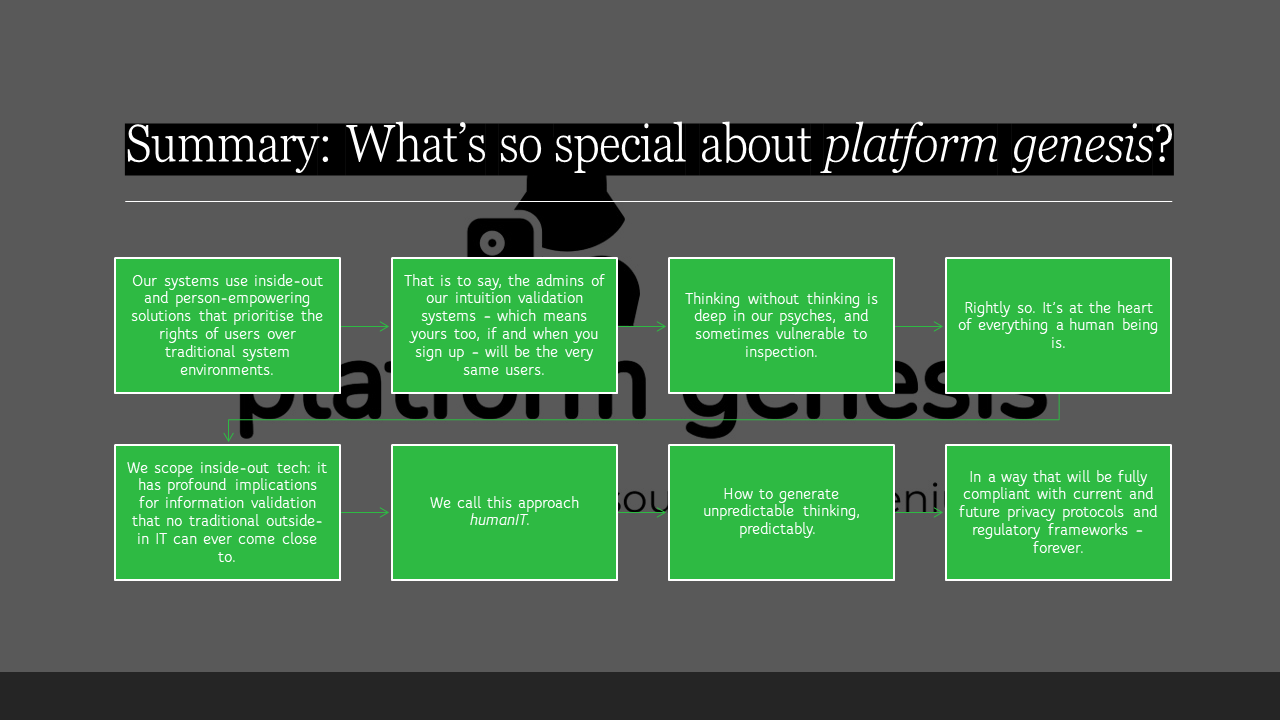
It started out, for me, with something that in 2019 I called the “intuition validation engine”. This has a direct line to something I described, on the spur of the moment during a discovery interview with a Liverpool university, late 2016, early 2017, as the “industrialisation of intuitive thought/thinking”.
I have three university qualifications. The first one is really important in respect of why, now, privacy sensitive innovation— or even secrecy positive invention — occupies me as it has done.
In 1983 I graduated from a BA Hons in Film & Literature. I realise, where it’s my dots I must connect, that it is directly to this degree all these years ago that they do.
Film has for over a hundred years chosen to create technologies which enhance and expand human beings, not diminish them.
Big tech, and specifically IT tech, has chosen, practically from its beginnings, to do the opposite: diminish human agency in order to maximise revenues from “machine wombs” that replace us, instead of concentrating on delivering “incubators” to make us all happier in our state as creative, interdependent, and thinking beings.
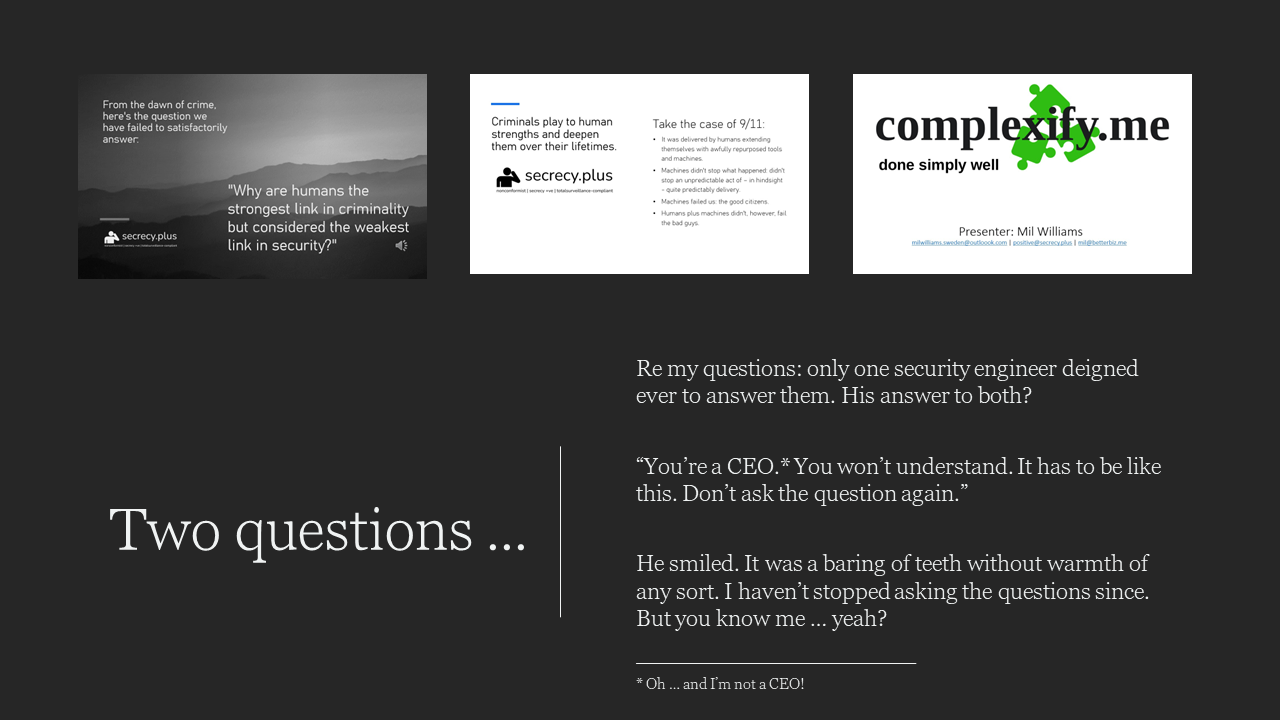
Why privacy sensitive innovation, then? Because we can’t think freely in what essentially amounts to the vice of total surveillance tech. A tech which fails to inhibit creative criminals such as those behind 9/11, Putin’s Russia, and now Hamas, but does succeed in making it difficult for good people to be at these awful people’s levels in order to fight back on equal terms.
It’s not just a question of crime. It’s also a matter of the big complex problems of our time (opens a page in our sister site, sverige2.earth). Climate change can’t be explained in an elevator pitch, but traditional startup ecosystems don’t know anything else.
Above, then, ten use cases: some started out on this site, others were ultimately pulled from our two sister sites, sverige2.earth and secrecy.plus.